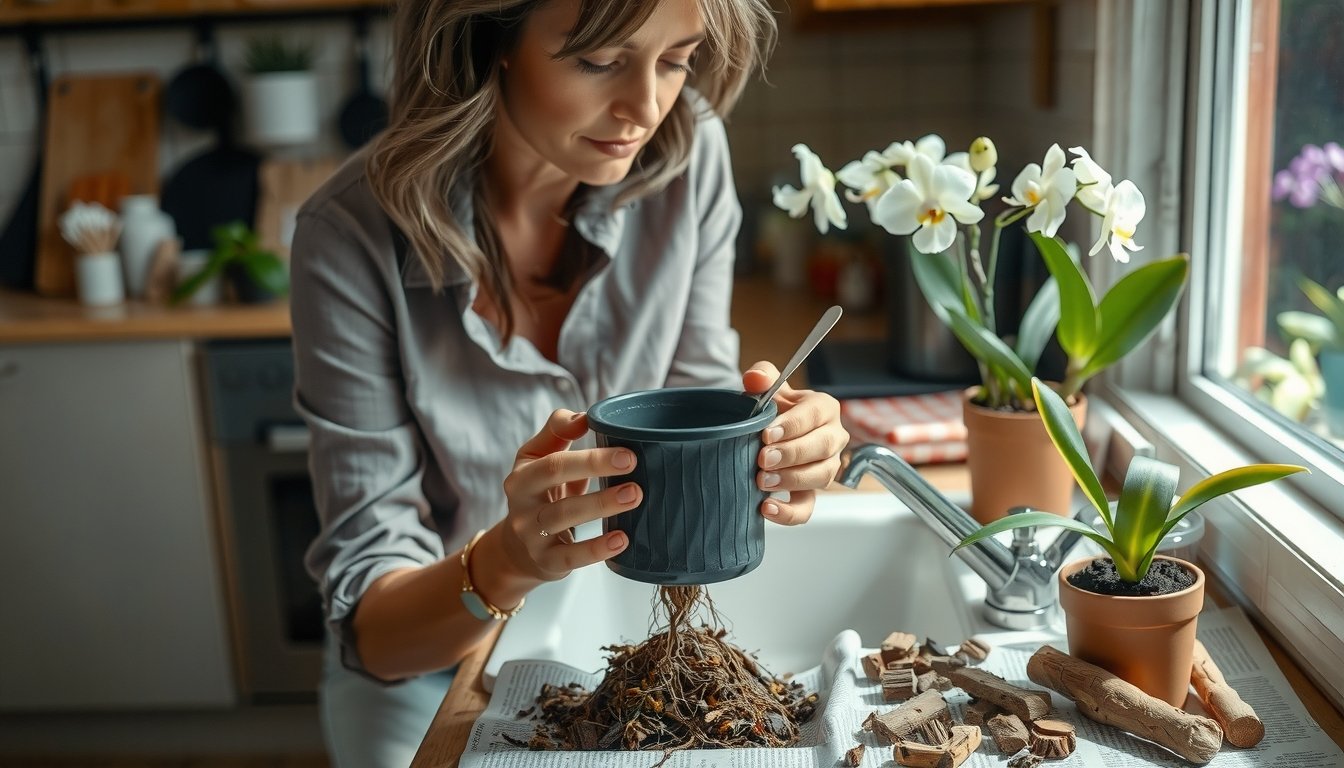
The roots are drowning in plain sight. They press against transparent plastic, pale and gasping, while you water on schedule like a dutiful lover who’s forgotten to listen. Your orchid isn’t dying because you’re neglectful—it’s suffocating because you care too much in all the wrong ways.
Most orchid advice treats these plants like fragile ornaments requiring mystical knowledge. The truth is rawer and more intimate: orchids are air-breathing creatures trapped in terrestrial prisons. In their native habitat, they cling to tree bark in humid forests, their roots exposed to constant air circulation, drinking mist and breathing freely between rains. We’ve sentenced them to plastic cells filled with bark that becomes a soggy tomb.
The Invisible Asphyxiation
Peel back the pretty performance your orchid stages with its blooms. Look at what’s happening in the darkness below. Those roots—thick, silvery when healthy, green-tipped when actively growing—need oxygen as desperately as they need water. Root respiration is the secret pulse that drives everything above: the architectural stems, the waxy leaves, those flowers that seem to float in defiance of gravity.
When potting medium stays wet for days, when bark decomposes into a dense mat, when that decorative cache pot has no drainage hole, the roots begin to drown. They can’t breathe. They can’t absorb nutrients. The velamen—that spongy outer layer designed to capture moisture from humid air—becomes waterlogged and useless. Root rot isn’t a disease that attacks; it’s a suffocation that spreads.
You’ll see it first in the roots themselves if you’re brave enough to look. Healthy roots are firm and pale silver-green, sometimes blushing with chlorophyll. Dying roots turn brown, mushy, hollow—collapsing inward like abandoned buildings. By the time the leaves yellow and wrinkle, the catastrophe below has been unfolding for weeks.

The Breathing Medium
Forget everything you know about potting soil. Orchids don’t want earth—they want air with occasional interruptions of moisture. The ideal medium is almost absurdly chunky: large bark pieces, perlite, charcoal, even wine corks. Some growers use nothing but lava rock. The goal isn’t to hold water but to create architecture—a scaffolding of air pockets where roots can sprawl and breathe.
When you repot (and you should, every two years minimum), handle those roots like you’re untangling something precious and alive, because you are. Trim away the dead with sterilized scissors—clean cuts, no mercy for the rotted sections. What remains might shock you with its scarcity, but healthy roots will regenerate faster than a compromised system struggling in bad medium.
Choose a pot that feels too small. Orchids bloom better when slightly root-bound, when they can dry out between waterings. Clear plastic isn’t just aesthetic—it lets you witness the root drama, lets you see when they’re plump and green-tipped versus when they’re pale and thirsting. This transparency is intimate intelligence.
The Watering Ritual Reimagined
Stop watering on Wednesdays. Stop following schedules invented by people who don’t live in your home with your humidity and your light. Water when the roots tell you to—when they’ve faded to pale silver, when the pot feels light as a secret, when you’ve stuck your finger into the medium and found it dry two inches down.
When you do water, make it a ceremony of abundance. Take the pot to the sink. Drench it completely—let water cascade through until it runs clear. Let the roots drink deeply, let the velamen swell with moisture. Then let it drain. Completely. For fifteen minutes, let gravity pull every excess drop away. Never let an orchid sit in standing water. Never trap it in a decorative pot without drainage unless you’re committed to lifting it out after every watering.
Some growers swear by the ice cube method. Ignore them. Orchids are tropical creatures; they don’t want frozen water slowly melting against their roots. They want room-temperature showers that mimic warm jungle rain, followed by air and light and the patient wait until the next deluge.

The Air Hunger
Humidity matters, but not the way you think. You don’t need a rainforest in your living room. You need air circulation. A small fan running on low nearby does more for orchid health than any misting routine. Moving air prevents fungal growth, speeds drying, mimics the breezes that would naturally flow through a forest canopy.
Those aerial roots that escape the pot and reach into empty air? They’re not confused—they’re remembering. Let them roam. They’ll turn green and plump when humidity rises, silver and dormant when air is dry. They’re breathing, sensing, seeking. They’re doing exactly what orchid roots evolved to do.
The Resurrection
If you’ve discovered your orchid gasping in soggy medium, if the roots are more brown than green, you haven’t necessarily lost it. Orchids are survivors—they’ve evolved to endure drought, to cling to bark through storms, to regenerate from almost nothing.
Repot immediately into fresh, chunky medium. Cut away all dead roots without hesitation. What remains might look like a few pale threads, but those threads contain possibility. Reduce watering frequency. Increase humidity around (not on) the plant. Wait. Growth will be slow—a single new root tip emerging like a green flame, a leaf that finally plumps instead of shriveling.
The next bloom spike, when it comes, will taste like victory. Not because you followed rules, but because you learned to listen to what your orchid’s roots were screaming silently all along: Let me breathe.