The Threshold Between Worlds
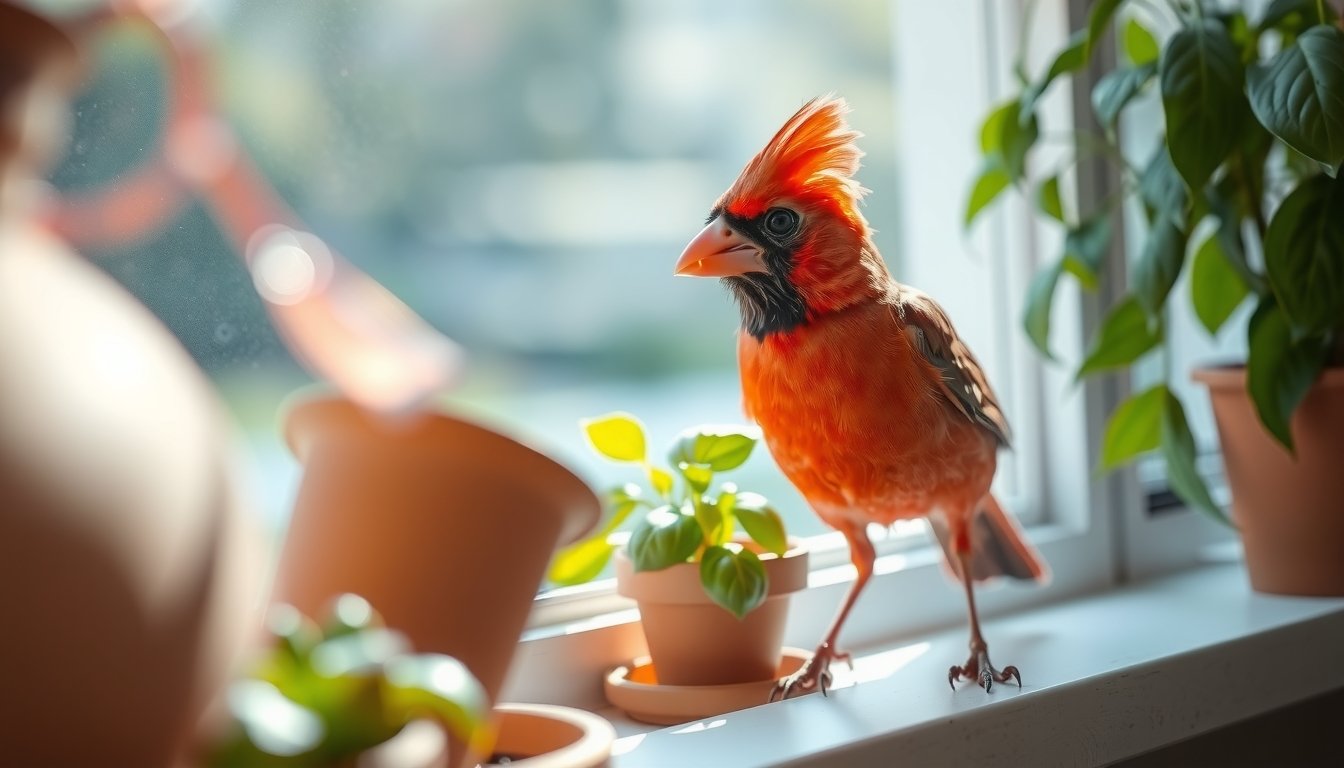
Your windowsill is not just a ledge. It’s a threshold—a place where the wild world meets your cultivated sanctuary, where feathers brush against the same surface that holds your basil seedlings and propagating pothos. When a bird lands there, folding its wings against the glass that separates you, something ancient stirs. This is not coincidence. This is conversation.
I’ve watched it happen in my own garden-rimmed windows: the sudden arrival, the tilted head, the unblinking eye that seems to see through more than glass. The herbs I’m rooting in mason jars tremble slightly from the vibration of tiny clawed feet. The bird doesn’t know it’s performing an act heavy with meaning—or perhaps it knows better than we do.
What the Windowsill Holds
Before we decode the visitor, understand what your windowsill represents. It’s the liminal space where your indoor garden breathes—where succulents drink morning light, where you’ve lined up your propagation experiments, where that struggling orchid sits in its final chance at resurrection. It’s charged territory, thick with the energy of growth and your attention.
Plants growing on windowsills exist in a state of beautiful tension. They’re neither fully inside nor completely outside. They press against the glass, reaching for what’s beyond, roots bound in pots while their leaves chase the sun’s arc across the sky. When a bird chooses this exact spot to land, it’s choosing the place where your cultivation meets the untamed.
The spiritual meaning shifts depending on the bird, but the core message remains: pay attention to the edges, to the boundaries, to what’s trying to cross over.
The Cardinal’s Burning Message
A cardinal on your windowsill is impossible to ignore—that slash of red against whatever backdrop your plants provide. In the language of gardens and growth, cardinals speak of vitality, of the life force that pushes green shoots through soil. They appear when you need to remember your own aliveness, your own capacity for bold growth.
If you’ve been timid with your pruning, hesitant to cut back that leggy pothos or divide that root-bound fern, the cardinal asks: Where are you afraid to be decisive? These birds mate for life, returning to the same territories year after year. They understand commitment to place, to growth, to the slow work of building something that lasts.
When I see one land near my windowsill herb garden, I check what needs harvesting. Usually, the basil has gone too long without pinching back, growing tall and bitter. The cardinal reminds me that aggressive pruning—the kind that feels almost cruel—is often what creates the lushest growth.

The Mourning Dove’s Quiet Wisdom
Mourning doves arrive like whispers, soft-bodied and gentle against your seedling trays. Their presence speaks to cycles, to the necessary periods of rest between growth spurts. If your windowsill garden is struggling—if those tomato seedlings look weak or that succulent propagation isn’t taking—the dove brings permission to pause.
In spiritual symbolism, doves represent peace, but in the context of your growing things, they represent something more specific: the peace that comes from accepting dormancy. Not everything needs to be actively growing all the time. Some seeds need cold stratification. Some bulbs need months of darkness. Some plants need to nearly die before they can truly thrive.
The mourning dove on your windowsill, cooing its melancholic song near your struggling houseplants, isn’t a bad omen. It’s a reminder that apparent death is often just transformation waiting for its moment.
The Sparrow’s Democratic Message
Common sparrows—brown, scrappy, abundant—land on windowsills without ceremony. They’re the weeds of the bird world, which means they’re survivors, adapters, the ones who thrive in disturbed soil and difficult conditions. When a sparrow chooses your plant-filled window, it’s speaking the language of resilience.
Your windowsill garden is probably full of plants that shouldn’t thrive but do: the grocery store basil you rescued, the succulent leaf you stole from a friend’s plant, the seeds you scattered in desperation. The sparrow sees itself in these survivors. It asks: What are you underestimating?
I’ve learned more from sparrows and struggling plants than from any pristine garden. They teach that beauty isn’t about perfection—it’s about persistence, about showing up day after day, about making do with whatever light and water and soil you can find.
The Crow’s Complicated Truth
If a crow lands on your windowsill, especially near your plants, something is shifting. Crows are messengers of transformation, but not the gentle kind. They speak of necessary destruction, of composting, of the rot that feeds new growth. They’re not afraid of death because they understand it as part of the cycle.
In your windowsill garden, the crow’s message might be harsh: Something needs to end. That plant you’ve been trying to save for months? It might be time to compost it. That propagation method that keeps failing? Try something radically different. The crow doesn’t believe in false hope—it believes in clearing away what’s dead to make room for what wants to live.
When a crow visited my window last spring, I finally admitted that my prized orchid was beyond saving. I cut it down, composted everything but the pot, and planted pepper seeds in the same spot. By summer, I was harvesting handfuls of shishitos. The crow knew what I was avoiding.
The Hummingbird’s Urgent Whisper
Rare but electric, a hummingbird at your window is pure urgency. These birds live at the edge of possible—their metabolism so fast they’re always hours from starvation, their flight so energetically expensive they shouldn’t exist. Yet they do, jeweled and impossible, hovering near your flowering houseplants.
The hummingbird asks: What are you waiting for? If you’ve been meaning to start seeds, to finally try propagating that difficult plant, to attempt the garden project that feels too ambitious—the hummingbird says the time is now. Not because you’re ready, but because readiness is a myth. You learn by doing, by failing, by trying again.
They’re drawn to red flowers, to tubular blooms, to nectar-rich offerings. If one appears at your window, consider what you’re offering the world. Is your garden—indoor or out—creating sweetness? Are you feeding what needs feeding?
What to Do When Birds Visit
The spiritual meaning is one thing. The practical response is another. When a bird lands on your windowsill, especially repeatedly:
Check your plants. Are they healthy? Struggling? Ready for repotting? The bird’s arrival often coincides with a need for attention in your green space.
Consider the season. Birds appear at windows during migration, during nesting season, during times of scarcity. Their presence reflects natural cycles that your plants are also experiencing.
Look at what’s blooming. If you have flowering plants on that sill, the bird might simply be investigating a food source. But even practical visits carry meaning—you’ve created something that feeds life.
Notice patterns. A single visit is interesting. Repeated visits are a conversation. Pay attention to what’s happening in your life and garden when the birds arrive.
The Windowsill as Oracle
Your windowsill garden, with its propagating cuttings and sun-hungry leaves, is already a form of divination. You’re reading the future in root growth, in new leaf unfurling, in the subtle signs that tell you whether something will thrive or fade. When a bird lands there, it’s another sign to read—another way the growing world speaks to those who are listening.
The spiritual meaning of a bird on your windowsill isn’t separate from the practical reality of your plants. It’s woven into it, as integrated as nitrogen in soil, as essential as light through glass. The bird, the plant, the gardener, the window—all part of the same conversation about growth, about cycles, about the persistent, urgent, beautiful work of staying alive.
Next time a bird lands near your seedlings and cuttings, don’t just note the species. Notice what you were thinking about. Notice which plant it’s closest to. Notice the quality of light, the time of day, the season of growth or dormancy. The message is there, written in feathers and leaves, waiting for you to translate it into action.
The threshold is thin. The birds know it. Your plants know it. Now you know it too.