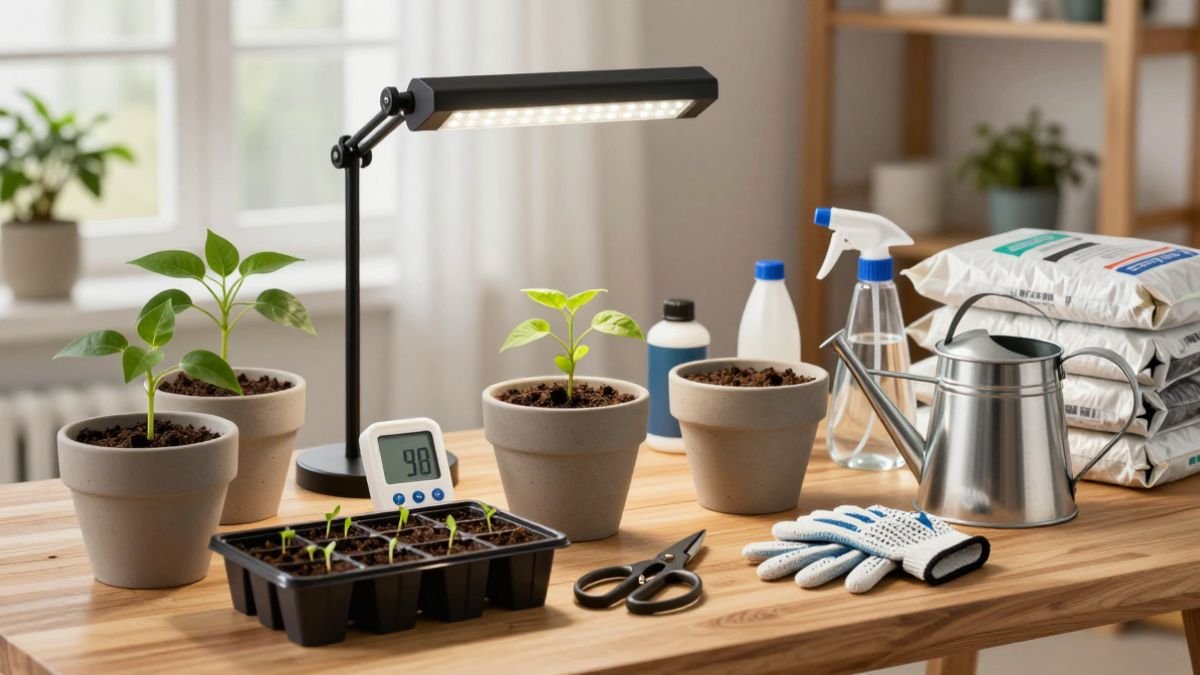
You bought the self-watering pot, the fancy pH meter, and the grow light that cost more than your monthly streaming subscriptions combined. Yet your basil is crispy, your pothos has root rot, and those “foolproof” seed pods never sprouted. Here’s the truth most retailers won’t tell you: indoor gardening failures aren’t about lacking a green thumb—they’re about missing two or three unsexy basics while your cart fills with gadgets that solve problems you don’t actually have.
Let’s fix that. This guide cuts through the clutter to show you the eight essentials that actually keep plants alive, plus the trendy supplies that belong in someone else’s closet.
What “enough light” actually means (and why your phone knows better than you)
Most indoor gardening advice says “bright indirect light,” which means absolutely nothing when you’re standing in your living room. Here’s the real test: download a free light meter app and measure your space in foot-candles. Leafy greens need 200–400 fc, herbs want 400–600, and fruiting plants demand 600+. That corner you thought was bright? Probably 50 fc on a good day.
If your numbers fall short, one clip-on LED grow light (the $25 kind, not the $200 smart panel) positioned 6–12 inches from your plants will outperform any amount of wishful thinking. Skip the purple “blurple” lights—they work, but the color makes it impossible to spot pests or deficiencies. Full-spectrum white LEDs let you actually see your plants while delivering the wavelengths they need.
The regret purchase: Those decorative Edison-bulb “grow lights” that look cute in plant corners but emit almost zero usable PAR (photosynthetically active radiation). If it doesn’t list lumens or PAR output, it’s décor, not horticulture.

The $8 timer that prevents 80% of beginner mistakes
Plants don’t care if you’re busy, traveling, or binge-watching a new series. They need consistent light cycles—14–16 hours for vegetables and herbs, 12–14 for houseplants. A basic mechanical or digital outlet timer removes the guesswork and the guilt.
Plug your grow light into the timer, set it once, and your plants get the same reliable “sunrise” every day. This single habit prevents the erratic light exposure that causes leggy seedlings, dropped leaves, and confused flowering.
The regret purchase: Smart plugs with app control and scheduling. They’re not wrong, just overkill. When the app updates or your Wi-Fi hiccups, your plants don’t get fed. Mechanical timers have worked since 1970 for a reason.
Trays, saucers, and the spill control nobody mentions
Water damage to furniture, windowsills, and floors is the hidden cost of indoor gardening. Every pot needs a saucer or tray that’s actually wider than the pot’s base—water doesn’t drip straight down, it runs along the outside.
For multi-plant setups, get a large plastic or metal tray (boot trays work beautifully) that can catch overflow and hold a little humidity. This also makes it easy to water thoroughly without tip-toeing around drips.
The regret purchase: Decorative ceramic saucers with no drainage lip, or worse, cache pots with no hole at all. They look great in photos, but they trap water, hide root rot, and make it impossible to know when you’ve overwatered.
Airflow to prevent the fungus gnat apocalypse
Stagnant air is an engraved invitation for fungus gnats, powdery mildew, and damping-off disease. A small clip-on fan running on low, aimed to gently rustle leaves, solves this. It doesn’t need to be strong—just enough movement to dry the soil surface between waterings and strengthen plant stems.
Bonus: airflow reduces the humidity pockets where pests love to breed, and it mimics the natural outdoor conditions that make plants sturdy instead of spindly.
The regret purchase: Expensive oscillating tower fans or “smart” air purifiers marketed to plant parents. A $15 desk fan does the same job without the app.
Potting mix vs. seed-starting mix (they are not the same thing)
This is where beginners lose weeks of progress. Potting mix is chunky, holds moisture, and contains bark, perlite, and peat or coco coir—it’s designed for established plants with developed roots. Seed-starting mix is fine, sterile, and light—it gives tiny seeds the moisture and contact they need to germinate without drowning or compacting.
Using potting mix for seeds leads to poor germination and damping-off. Using seed-starting mix for mature plants leads to poor drainage and weak root systems. Keep both on hand, and use each for its intended purpose.
The regret purchase: “All-purpose” soils from big-box stores that are mostly peat and wood chips. They compact fast, dry out unevenly, and often contain fertilizer that burns seedlings. Spend the extra $4 on a real potting mix from a garden center.
Watering tools that prevent overwatering (the #1 killer)
More plants die from too much water than too little. A long-spout watering can lets you water the soil directly, not the leaves, and control the flow so you’re not flooding the pot. Pair it with a moisture meter (the analog kind with the metal probe, about $10) so you can check the root zone before you water.
The rule: water when the top 1–2 inches of soil are dry for most houseplants, or when the meter reads “dry” in the root zone. For seedlings and herbs, keep the top half-inch consistently moist but not soggy.
The regret purchase: Self-watering pots and globes. They work for some people, but they remove your ability to learn your plants’ needs, and they often lead to root rot because the soil stays too wet for too long. Learning to water correctly beats outsourcing it to a gadget.
Pest prevention kit (because an ounce of prevention beats a gallon of neem)
You don’t need a shelf full of sprays. You need three things: yellow sticky traps (for fungus gnats and whiteflies), insecticidal soap or diluted Dr. Bronner’s (for aphids and spider mites), and a spray bottle for application and leaf cleaning.
Check plants weekly, especially new arrivals and the undersides of leaves. Catching pests early means a quick spray fixes it. Ignoring them for a month means you’re battling an infestation.
The regret purchase: Neem oil as a first-line defense. It works, but it’s messy, smells terrible, and requires repeat applications. Use it for stubborn cases, not as your everyday prevention.

The minimal starter list (and when to upgrade)
If you’re just beginning, here’s your shopping list:
- One clip-on LED grow light (full-spectrum white, 20–40W)
- One outlet timer (mechanical or digital)
- One watering can with a long spout
- One moisture meter
- One bag of potting mix and one bag of seed-starting mix
- One plastic tray or boot tray
- One small clip-on fan
- Yellow sticky traps and insecticidal soap
Total cost: under $100. This setup will keep herbs, greens, and houseplants thriving in most indoor spaces.
Upgrade when you’ve successfully kept plants alive for three months and you know your specific needs—maybe a larger grow light, a humidity tray, or a propagation station. Let your experience guide your spending, not Instagram ads.
What to skip (and why)
Avoid these until you’ve mastered the basics:
- Smart sensors and app-connected systems: Expensive, prone to connectivity issues, and they don’t teach you to read your plants.
- Hydroponic kits for beginners: They’re cool, but they require precision and monitoring that soil naturally buffers.
- Decorative pots without drainage holes: No matter how cute, they’re root rot waiting to happen.
- Seed-starting heat mats (unless you’re germinating peppers or tropicals in a cold house): Most seeds sprout fine at normal room temperature.
- pH meters and EC meters: Useful for advanced growers, overkill for potting mix and tap water.

Your next step
Pick one plant you want to grow—basil, pothos, lettuce, whatever excites you. Buy only the supplies from the minimal list that you don’t already own. Set up your light and timer, water when the soil is dry, and run that fan.
Give yourself eight weeks. That’s enough time to see real growth, catch and fix one mistake, and build the confidence that turns indoor gardening from a Pinterest fantasy into a reliable source of fresh greens, cleaner air, and the quiet satisfaction of keeping something alive.
The gadgets will still be there if you decide you need them. But chances are, you won’t.