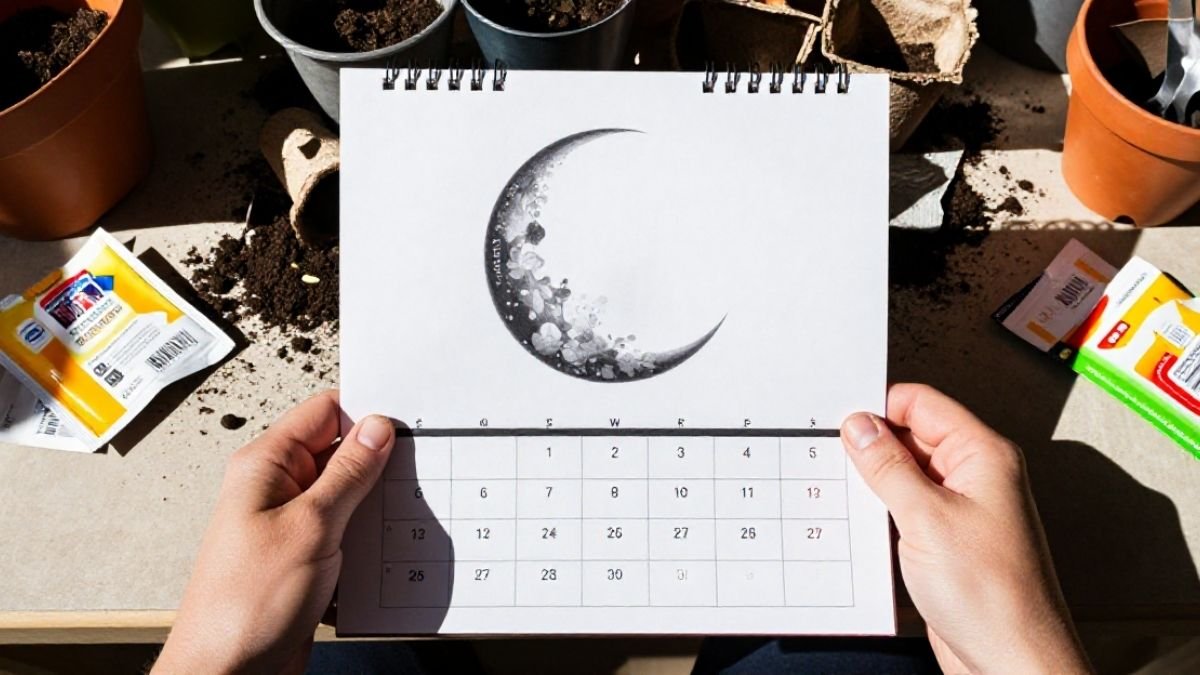
Your grandmother swore by it. Your neighbor with the prize-winning tomatoes mentions it every spring. But when you Google “moon gardening,” half the results call it ancient wisdom and the other half call it superstition. So what’s the truth?
Gardening by the moon—the practice of timing your planting, pruning, and harvesting according to lunar phases—has been around for millennia. Farmers in ancient Babylon tracked the moon. Indigenous peoples across the Americas planted corn when the moon was waxing. Even the Old Farmer’s Almanac, first published in 1792, includes lunar planting calendars to this day.
But does it actually work? Or is it just folklore dressed up as gardening advice?
Let’s dig in.
What is moon gardening?
Moon gardening is based on a simple idea: the moon’s gravitational pull affects moisture in the soil the same way it controls ocean tides. Since plants are mostly water, proponents believe lunar phases influence how quickly seeds germinate, how deeply roots grow, and how vigorously plants produce fruit or flowers.
The practice divides the lunar month into four phases, each supposedly ideal for different tasks.
New moon to first quarter (waxing): Plant crops that produce above ground and bear seeds outside the fruit—think lettuce, spinach, broccoli, and grains. The theory? Moonlight increases each night, encouraging leaf growth.
First quarter to full moon (waxing): Plant crops that produce above ground but bear seeds inside the fruit—tomatoes, peppers, beans, squash. The moon is still gaining light, and gravitational pull is said to draw water up into stems and leaves.
Full moon to last quarter (waning): Plant root vegetables like carrots, potatoes, beets, and onions. As the moon’s light decreases, energy supposedly moves downward into roots.
Last quarter to new moon (waning): Rest. No planting. Use this time to weed, prune, mulch, or harvest. Growth is minimal, so plants recover faster from stress.
That’s the framework. Now let’s examine the claims.
What gardeners say vs what science says
Walk into any garden club meeting and you’ll find passionate moon gardeners. They’ll tell you their seeds sprout faster, their carrots grow longer, and their roses bloom more abundantly when planted by lunar phases.
And they’re not making it up—many truly see better results. But is it the moon, or something else?
The science is mixed. Studies on lunar gardening are surprisingly sparse. A 1930s study found no difference in radish growth based on moon phases. A 2013 paper in the Journal of Agronomy concluded lunar planting had “no significant effect” on crop yield. However, a few small-scale experiments have shown marginal improvements in germination rates when seeds are planted during waxing moons.
Here’s the catch: those improvements could be due to weather patterns, soil moisture, or simple observation bias. If you’re paying closer attention to your garden because you’re following a lunar calendar, you’re probably watering more consistently, checking for pests more often, and harvesting at peak ripeness. That care matters more than the moon.
But the moon does influence one thing: soil moisture. During a full moon, gravitational pull is stronger, which can draw moisture upward in the soil profile. Some farmers believe this makes it easier for seeds to absorb water and germinate. It’s plausible, though hard to prove in controlled studies.
How to try a 30-day moon gardening experiment at home
Curious? Here’s how to test it yourself without turning your entire garden into a lunar lab.
Choose one crop. Pick something fast-growing like radishes, lettuce, or beans. You’ll see results in 30–60 days.
Split your planting. Plant half your seeds during a waxing moon (new moon to full moon). Plant the other half during a waning moon (full moon to new moon). Label them clearly.
Keep everything else identical. Same soil, same watering schedule, same sunlight. The moon is the only variable.
Track and measure. Note germination speed, plant height at 2 weeks, and final harvest weight or quality. Take photos.
After one growing season, you’ll have your own data. Maybe you’ll become a moon gardening convert. Maybe you’ll decide it’s bunk. Either way, you’ll learn something about your plants.

Best plants to try by moon phase
If you want to follow a lunar planting calendar, here’s a beginner-friendly breakdown by plant type.
Leaf crops (new moon to first quarter): Lettuce, spinach, kale, cabbage, celery, parsley.
Fruit crops (first quarter to full moon): Tomatoes, peppers, cucumbers, melons, squash, beans, peas.
Root crops (full moon to last quarter): Carrots, beets, turnips, radishes, potatoes, onions, garlic.
Perennials and bulbs (full moon to last quarter): Tulips, daffodils, asparagus, rhubarb.
No planting (last quarter to new moon): Focus on weeding, composting, turning soil, pruning dead branches, or planning next season.
Your printable lunar planting calendar
Here’s a simple reference you can pin above your potting bench or save to your phone.
Phase 1 – New moon (dark sky): Plant leafy greens and herbs. Sow seeds for fast-growing annuals.
Phase 2 – First quarter (half-lit, growing): Plant fruiting crops like tomatoes, beans, and peppers.
Phase 3 – Full moon (bright sky): Plant root vegetables. Transplant perennials.
Phase 4 – Last quarter (half-lit, fading): Rest. Weed, prune, and prepare beds for the next cycle.
You can find free lunar calendars online or use apps like Moon Phase Calendar or The Moon: Calendar Moon Phases to track the current phase in real time.

The real secret: paying attention
Here’s what I think after researching this topic: moon gardening works not because of magic, but because it makes you intentional.
When you follow a lunar calendar, you’re forced to plan. You can’t just throw seeds in the ground whenever you remember. You have to check the phase, prepare the soil, and show up at the right time. That discipline alone will improve your garden.
Does the moon have a measurable gravitational effect on soil moisture? Possibly. Does that effect matter as much as consistent watering, good compost, and pest management? Probably not.
But if believing in the moon gets you outside with your hands in the dirt, then it’s doing its job.
Try it for one season
You don’t have to overhaul your entire gardening routine. Start small. Pick one bed or one crop. Follow the lunar phases for 90 days and see what happens.
Maybe your tomatoes will be legendary. Maybe you’ll see no difference at all. Either way, you’ll have spent three months tuning into the rhythm of your garden, the sky, and the seasons.
And that’s the real harvest.