You can smell the difference between a well-ventilated greenhouse and a stagnant one before you even step inside. That musty, damp odor is your first clue that air isn’t moving—and where air stagnates, mold, mildew, and disease thrive. A walk-in greenhouse should feel like a breath of fresh air, not a sauna that breeds problems. The secret isn’t just about having vents; it’s about designing an airflow system from the ground up.
Most first-time greenhouse buyers focus on size, aesthetics, or price. They overlook the single factor that will determine whether their seedlings flourish or their tomato plants develop powdery mildew by mid-June: ventilation architecture. Let’s walk through the six design decisions that separate a cozy, productive greenhouse from a mold factory.
Minimum size that feels usable
A walk-in greenhouse smaller than 6 feet wide quickly becomes claustrophobic and limits your ability to create airflow corridors. When you can’t move comfortably between benches, you can’t inspect plants, prune effectively, or position fans where they’re needed.
Aim for at least 6 feet by 8 feet as a functional minimum. This gives you room for a central aisle, benches on either side, and enough cubic air volume to buffer temperature swings. Smaller structures heat up and cool down too fast, creating condensation cycles that encourage fungal growth.
Remember: air needs space to circulate. A cramped greenhouse is a humid greenhouse, no matter how many vents you install.

Roof vent and side vent pairing
Hot air rises. This isn’t just a physics factoid—it’s the foundation of passive greenhouse ventilation. A roof vent at the peak allows warm, moisture-laden air to escape naturally. But a roof vent alone creates a vacuum problem: where does replacement air come from?
That’s where side vents or louvered panels near the base come in. Cool air enters low, warms as it rises, and exits through the roof. This creates a convection loop that runs automatically on sunny days, no electricity required.
For a standard 8-foot-wide greenhouse, install at least one roof vent spanning 2 to 3 feet, and two side vents on opposite walls near ground level. If your greenhouse has a door on one end, prop it open during warm months—it doubles as a giant side vent.
Automatic vent openers (wax-cylinder actuators) are worth every penny. They respond to temperature changes and open vents gradually, preventing the shock of sudden cold drafts on tender seedlings.
Fans: where they go and why
Passive vents handle mild days beautifully. But in late spring and summer, especially in humid regions, you need mechanical airflow. Stagnant pockets of air are where problems hide.
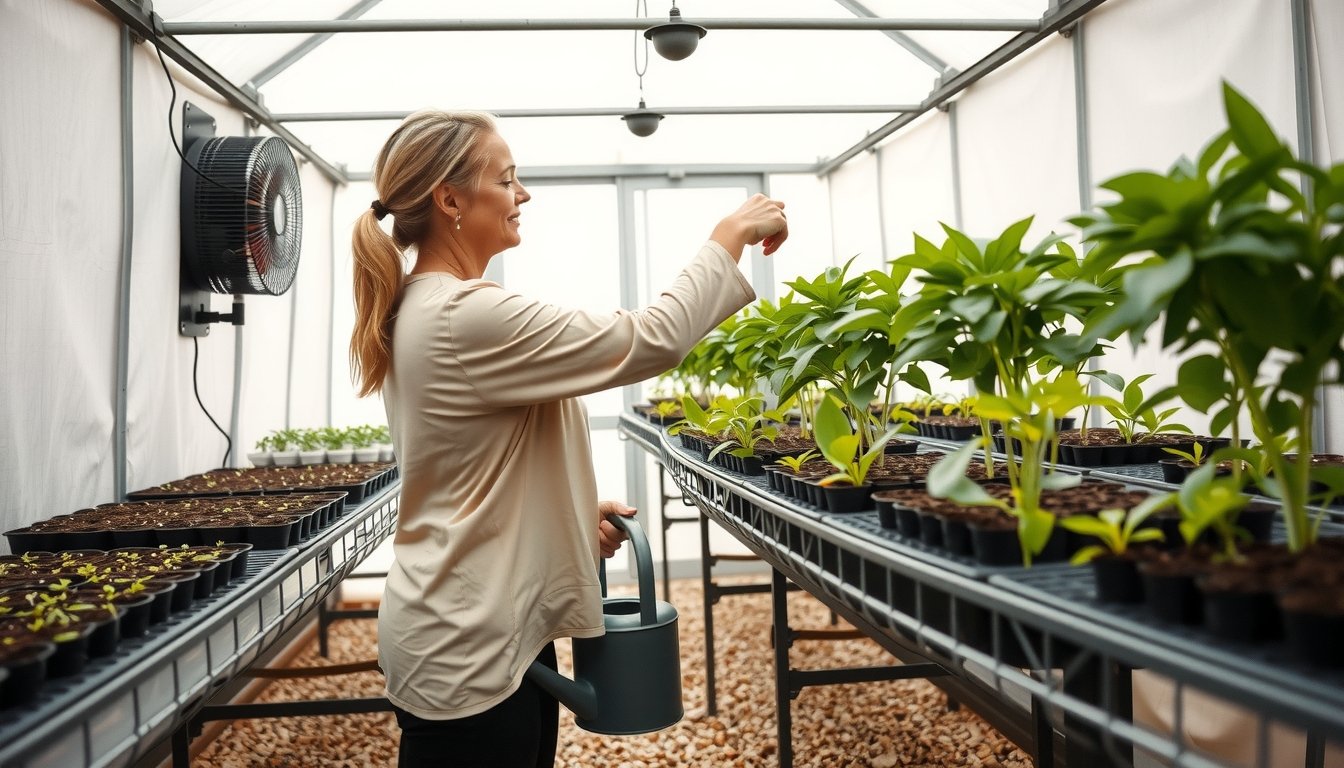
Mount a small circulation fan (6 to 8 inches) at one end of the greenhouse, aimed across the canopy—not directly at plants. The goal is gentle, continuous movement, like a breeze, not a wind tunnel. This prevents moisture from settling on leaves overnight, the prime condition for mildew.
If your greenhouse exceeds 10 feet in length, add a second fan at the opposite end, creating a figure-eight airflow pattern. Run fans on a timer: 15 minutes every hour during the day, and intermittently at night if humidity climbs above 70 percent.
In extreme heat (above 85°F), consider an exhaust fan mounted high on one end wall, paired with an open vent or door on the opposite end. This creates a horizontal air current that pulls heat out fast.

Flooring choices that reduce humidity
What’s under your feet matters more than you think. Bare soil, mulch, or grass inside a greenhouse releases moisture constantly, especially after watering. That moisture has nowhere to go if ventilation is weak.
Gravel or paver flooring dramatically reduces ambient humidity. A 2- to 3-inch layer of pea gravel over landscape fabric provides excellent drainage, reflects light upward to lower leaves, and stays dry between waterings.
Wood chips and bark mulch look natural but hold moisture and decompose, inviting fungus gnats and mold. If you prefer a softer surface, use crushed stone or decomposed granite instead.
Concrete is overkill for most hobby greenhouses, but if you’re building a permanent structure, a poured slab with a slight slope toward a drain is the ultimate low-humidity solution.
Bench placement for an airflow loop
How you arrange benches and shelving determines whether air can move freely or gets trapped in dead zones. Avoid pushing benches flush against walls—leave at least 6 inches of clearance on all sides.
Position benches parallel to the long axis of the greenhouse, with a central aisle. This layout channels airflow from door to vents without obstruction. If you must use corner shelves, keep them open-wire or slatted, never solid.
Raise benches at least 30 inches off the ground. This creates an air layer beneath pots, reducing root-zone humidity and discouraging pests like slugs. Wire mesh or slatted wood bench tops allow drainage and air penetration; solid surfaces trap moisture.
Leave the center aisle clear. It’s tempting to cram in extra plants, but a cluttered aisle blocks airflow and makes it harder to spot early signs of disease.

Simple seasonal routine (shade and heat)
Ventilation needs shift with the calendar. In late spring and summer (May through August in the northern U.S.), your greenhouse battles heat and humidity. Maximize vents, run fans daily, and add shade cloth (30 to 50 percent) over the roof to reduce solar gain. Shade cloth lowers interior temperatures by 10 to 15 degrees and cuts down on moisture stress.
In fall and winter, the challenge flips: you need to retain warmth while preventing condensation. Close vents partially, but never completely—stagnant winter air breeds botrytis and damping-off. Crack a vent or door for 20 minutes each morning to purge overnight humidity, even on cold days.
If you heat your greenhouse, use a thermostatically controlled heater with a built-in fan. Forced-air heat distributes warmth evenly and keeps air moving. Radiant heaters create hot and cold pockets.
Check for condensation on glazing every morning. Persistent water droplets mean ventilation is inadequate. Wipe down interior surfaces weekly to remove algae buildup, which thrives in high humidity and blocks light.
The difference is in the details
A walk-in greenhouse is a living system, not a static shed. Air, light, and moisture interact every hour of every day. When you design around airflow first—choosing the right size, pairing vents, positioning fans, selecting dry flooring, arranging benches thoughtfully, and adapting to seasons—you create an environment where plants thrive and problems stay rare.
Start by auditing your current setup or planning your new one. Walk through it mentally: where does air enter, where does it exit, and are there any dead zones? Make one improvement this week—add a vent, reposition a fan, or lay down gravel—and watch how quickly your greenhouse transforms from a worry into a joy.